Whatnot Drops to 0% Above $1,500. eBay’s Cliff Doesn’t Hit Until $7,500.
On January 14, Whatnot dropped commission to 0% on the portion of any single order above $1,500. The 8% rate still applies to the first $1,500. Sports card singles — not breaks — plus a handful of other singles categories. Breaks are excluded.
That’s still the rate today. 105 days in.

eBay’s published trading-card fee has a tier structure too. It’s just set at a different number. 13.25% on the first $7,500 of any single sale, then 2.35% on the portion above.
Whatnot’s break hits at $1,500. eBay’s hits at $7,500. That’s a 5x difference in threshold.
Run the math on a $5,000 single.
On Whatnot: $120 in commission (8% of $1,500), plus payment processing. Effective rate, roughly 5.3%.
On eBay: 13.25% on the full $5,000 — $662.50 — because eBay’s lower tier hasn’t kicked in yet. Effective rate, 13.25%.
Gap: roughly 8 percentage points. About $400 sitting on the seller’s side of the table on Whatnot that would be on eBay’s side.
Now run $10,000.
Whatnot: still $120 in commission. Effective rate, roughly 4.1% all-in.
eBay: 13.25% on the first $7,500 plus 2.35% on the next $2,500 — $993.75 plus $58.75 — totals $1,052.50. Effective rate, 10.5%.
Now run $20,000. Whatnot still $120. eBay $1,287.50 (effective 6.4%). The gap is still real, but it narrows as the sale climbs, because eBay’s own tier kicks in once you cross $7,500.
The war zone is the band between $1,500 and $7,500. That’s the bracket where Whatnot is now charging zero on the portion above $1,500 and eBay is still charging 13.25% on every dollar.
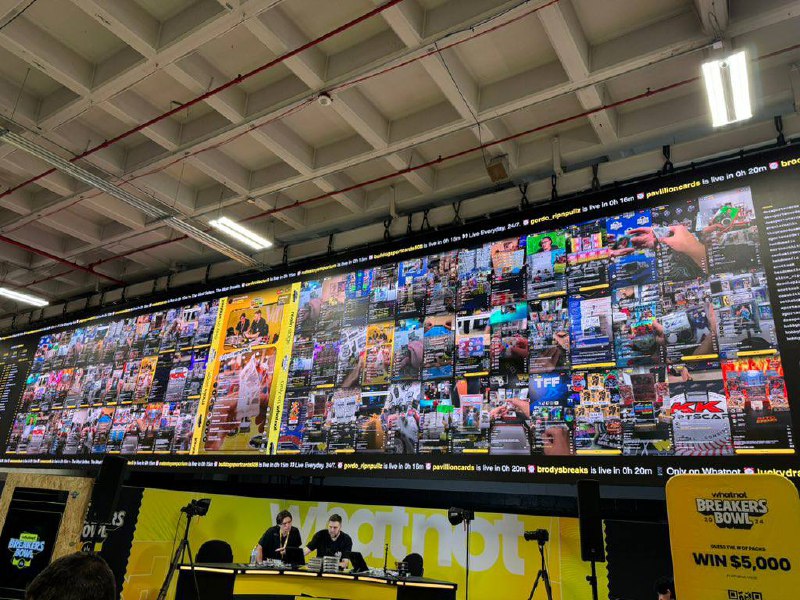
Whatnot calls this a “limited time promotion.” It has been live for over three months. It is the structure now.
This isn’t fee competition. It’s a high-end land grab — and it’s pointed directly at singles, not breaks.
That distinction matters. Whatnot already wins breaks. Live formats, instant pulls, breaker rosters that have been on the platform for years — that war is over. Where Whatnot has not won is the consignor sitting on a $25K Pop 1 vintage card or a $40K Logoman, who still ships to Goldin or lists on eBay. That’s the seller this fee structure is built to flip.
The platform was built on $30 to $300 break slots. The high-end singles sellers — graded vintage consignors, Pop 1 holders, dealers who never wanted to livestream — those people stayed on eBay or went to auction houses.
Killing commission above $1,500 on singles is an attempt to pull them. Especially in the $1,500-to-$7,500 sweet spot, where eBay still charges 13.25% and Whatnot is now charging zero on the portion above the floor.

A few things follow.
First — Whatnot is willing to subsidize high-end singles activity because it changes the perception of the platform. The hobby looks different when the $50K Mantle and the $25K Hobby Reserve T206 close on Whatnot livestreams instead of eBay storefronts. Top-of-market tonnage builds gravity.
Second — eBay’s $7,500 threshold hasn’t moved. eBay’s hobby category did $233 million in March. The $1,500-to-$7,500 band is the most contested slice of that number. If Whatnot peels off even ten percent of singles volume in that bracket, that’s a real dent.
Third — the 8% under-$1,500 rate is the actual revenue line. Whatnot is not running this to make money on a $20K Logoman. It’s running it to make sure the next $20K Logoman seller signs up at all, then sells fifty $400 graded singles while they’re on the platform.
Fee architecture is strategy. Whatnot already owns breaks. This is the move on singles. The war zone is between $1,500 and $7,500.
eBay has not adjusted the threshold. The $7,500 line is still $7,500.
That’s the data point.