How Fleer Sold America a Quality Control Disaster—and Made It Worth Thousands
Here’s what you need to understand about the 1989 Fleer Billy Ripken “FF” card: it’s not valuable because of anything Billy Ripken did. The guy hit .207. He posted a -1.6 WAR for one of the worst teams in baseball history. His career OPS+ was 68, meaning he was 32% worse than a league-average hitter over eight forgettable seasons.
Billy Ripken’s 1989 Fleer card #616 is worth thousands of dollars because someone—Ripken himself, a teammate playing a prank, or Fleer’s own production crew—put the words FUCK FACE on his bat knob, photographed it, and then sent it to every card shop in America.
And then Fleer made it worse. In their panic to fix the unfixable, they created a dozen correction variants, each more half-assed than the last, distributed inconsistently, tracked by nobody, and now worth anywhere from $20 to nearly $5,000 depending on which botched cover-up job you’re holding.
This is the story of how a quality control failure became a market phenomenon. And why, thirty-six years later, a backup infielder’s batting practice bat is one of the most obsessively collected artifacts in the junk wax era.
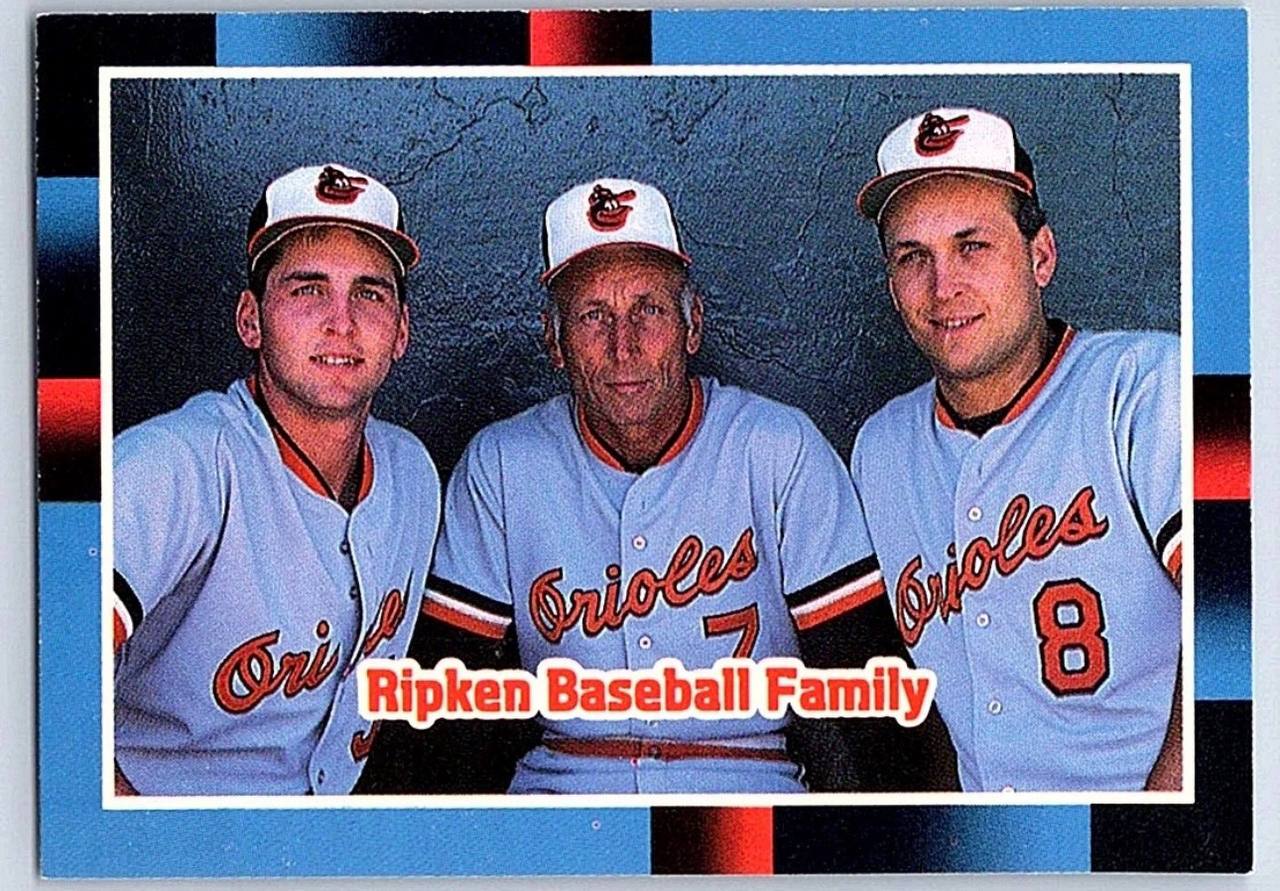
Billy Ripken broke into the majors with Baltimore in 1987 as the younger brother of Cal Ripken Jr.—the Cal Ripken Jr., the Hall of Famer who played 2,632 consecutive games and is one of the most beloved figures in baseball history. Billy rode shotgun on that legacy. By 1988, he was the everyday second baseman in the same infield as Cal Jr., managed by their father Cal Sr.
It sounds like a great story. It wasn’t.
The 1988 Orioles went 54-107, the worst record in franchise history. Cal Sr. got fired six games in. Billy hit .207 with 2 home runs. He was, by any honest measure, a replacement-level player holding down a starting job partly on family name and the organization’s willingness to develop youth rather than win games.
Nobody cared about Billy Ripken’s 1989 Fleer card.
Until they opened the packs.
In early 1989, Fleer’s new baseball set hit card shops. Somewhere around the second or third time a collector really looked at Billy Ripken’s card—number 616—the hobby exploded.
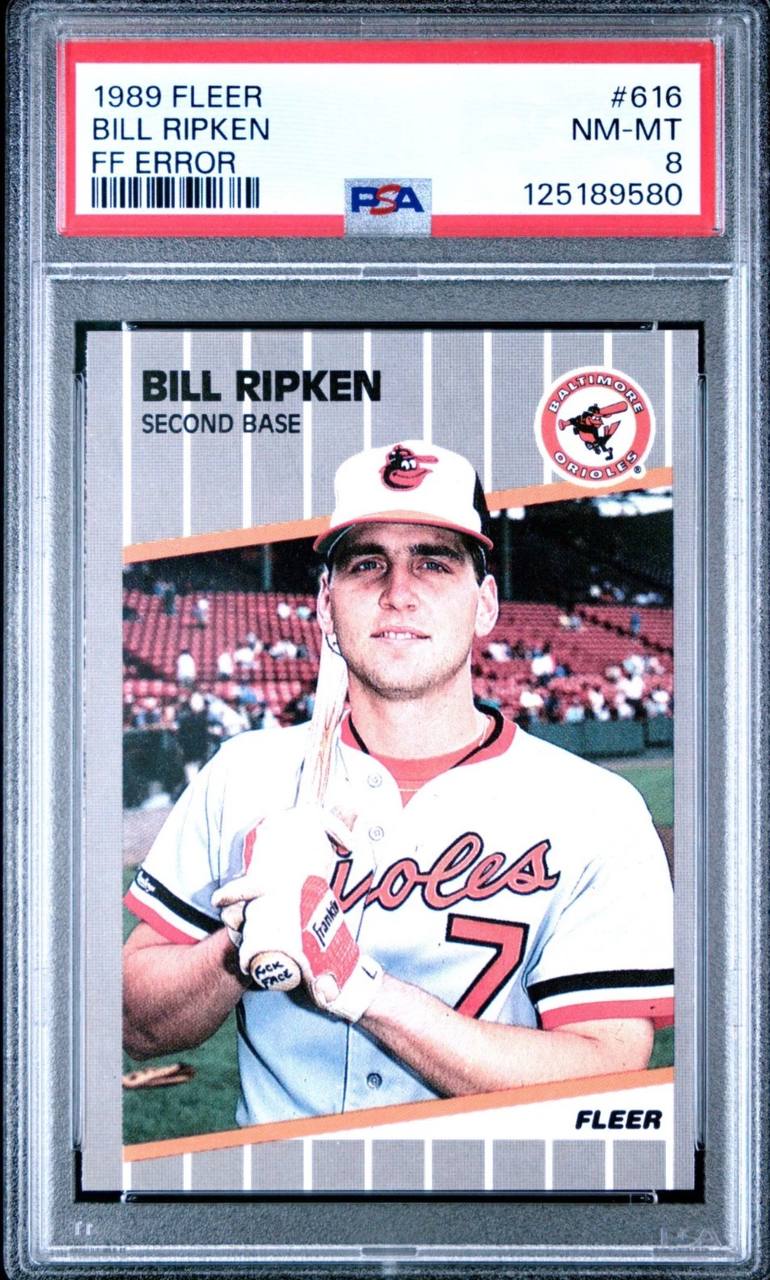
On the bat knob, clearly legible, were two words:
FUCK FACE.
Not ambiguous. Not a smudge. Written in black marker, bold as you please, on the bat Ripken was holding in his official Fleer photograph. And somehow—somehow—it made it through photography, editing, production, quality control, printing, packaging, and distribution to land in the hands of collectors across America.
In an era before the internet, this story spread the only way it could: word of mouth at card shops and shows, hobby magazines, playground gossip. Within weeks, the card went from pennies to $20—enormous money in 1989, when wax packs cost fifty cents. Mainstream news picked it up. The price hit $300. Boxes of 1989 Fleer that retailed for $25 were suddenly selling for $100.
“It appears I was targeted by teammates. I know I’m kind of a jerk at times. I know I’m a little off. But this is going too far.”
— Bill Ripken, 1989
That was Ripken’s original statement. He blamed teammates. He played the victim. But in 2008—nearly 20 years later—he gave a detailed interview to CNBC’s Darren Rovell and finally told the real story.
He had a set of bats that were too heavy for games. He kept one for batting practice and marked it so he could find it fast in a crowded bat room. The marking he chose—two words on the knob—was crude, personal, and absolutely not meant for public consumption. He was photographed at Fenway Park by a Fleer photographer who tapped him on the shoulder after BP. The bat was in frame. He never thought about it again.
Until January 1989.
“I can’t believe the people at Fleer couldn’t catch that. I mean, they certainly have to have enough proofreaders to see it. I think not only did they see it, they enhanced it. That writing on that bat is way too clear. I don’t write that neat.”
— Bill Ripken, CNBC, 2008
Let’s be honest: yes, probably.
Upper Deck had just launched in 1989 with premium product that was threatening Fleer’s market position. The timing is suspicious. The clarity of the text is suspicious—Ripken himself said the writing was “too clear.” The fact that it survived every stage of production—photographer to editor to printer to quality control—is beyond suspicious. It’s absurd.
No one from Fleer ever admitted to anything, and the company has been out of business since 2007. But consider the incentives: a scandal card drives box sales. Media coverage drives box sales. Controversy drives box sales. And Fleer, facing real competition for the first time in years, needed every advantage it could manufacture.
Did they enhance the text? Did they intentionally let it slide through production? We’ll probably never know for certain. But the alternative explanation—that a dozen people at a professional card company all missed a giant profanity on a bat knob in a close-up photograph—is harder to believe than the conspiracy.
When the scandal broke, Fleer panicked. They couldn’t recall millions of cards. They couldn’t admit fault. So they did what any company in full damage-control mode does: they made it worse.
Fleer scrambled to “fix” the card mid-production, creating correction variants on the fly—each one slightly different, distributed inconsistently, tracked by nobody. The result is one of the most complex variant families in hobby history. The grading companies (primarily PSA) formally recognize five. Expert collectors and dedicated researchers—most notably the team behind BillRipken.com, who’ve spent 30+ years cataloging these—document well over a dozen micro-variants when you account for sub-types.
Here’s the honest breakdown.
1. Original “FF” (Uncensored)
The one that started everything. Full text visible on the bat knob, unaltered. This is the most widely available version—Fleer printed millions before the error was discovered. PSA has graded nearly 2,900 copies in gem mint (PSA 10), which tells you how many raw copies are out there.
Market: Raw copies trade between $40–$80 in average condition. PSA 10 grade: approximately $600–$750.
The card is common. The story is priceless.
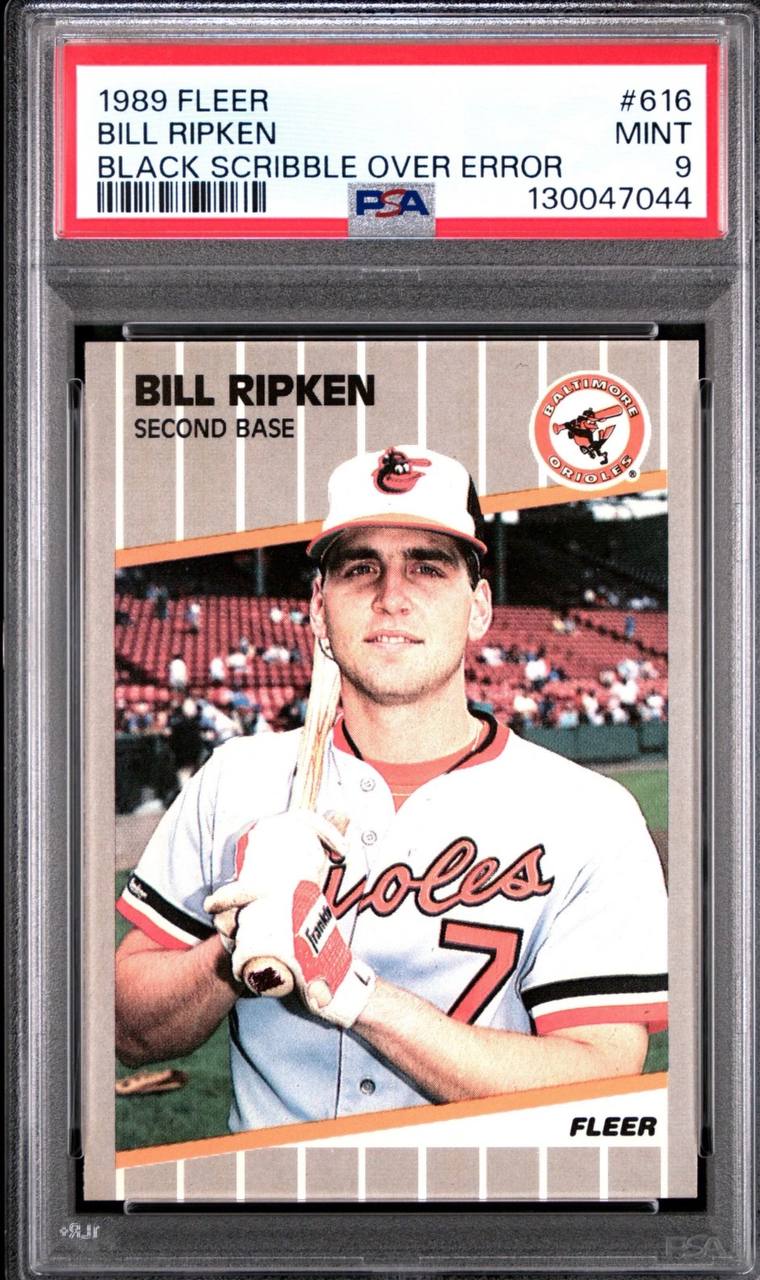
2. Black Scribble
Fleer’s first attempt at a fix—a horizontal black marker scribble over the text. But here’s the thing: there are at least three distinct sub-variants within this category.
1. Scribble with the first “F” still visible
2. Scribble with an airbrush loop partially removing the first letter
3. Scribble with the first letter fully removed
PSA tracks these collectively under “Black Scribble Over Error.”
PSA 10 population: approximately 281–286 graded copies
PSA 10 recent sales: $535–$660 (2025 range)
PSA 9: $65–$100
One of the more accessible variants for budget collectors wanting something beyond the original.
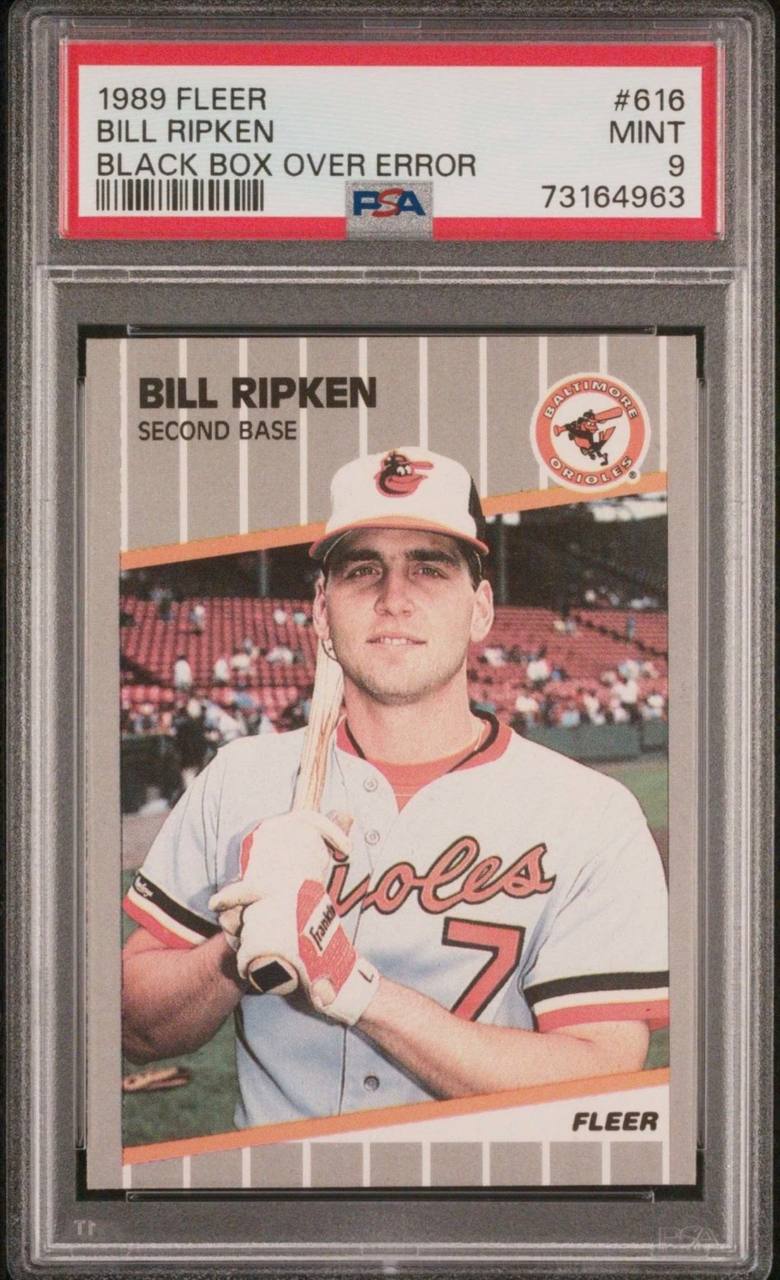
3. Black Box
A clean, solid black rectangle placed over the bat knob. This was Fleer’s most common “official” correction, printed across multiple full 132-card production sheets.
Sub-variants exist here too: a version with four square corners versus one with a rounded upper-left corner, and a further sub-type with what researchers call a “jagged white” line in the card’s upper left corner.
PSA 10 population: approximately 1,135—the most common correction variant
PSA 10 recent sales: as low as $96 (January 2026)
Budget pick for the set collector: raw copies are easy to find under $20.
4. Black Box Glossy (Collector’s Edition)
A variant within a variant—the rounded Black Box version that ended up in Fleer’s premium Glossy/Collector’s Edition set. These have the characteristic blue “Collector’s Edition” branding.
Rarely discussed in mainstream price guides, but genuinely sought after by completionists building the full Ripken FF run. Harder to find than the standard Black Box but lacks the graded population data of the major variants.
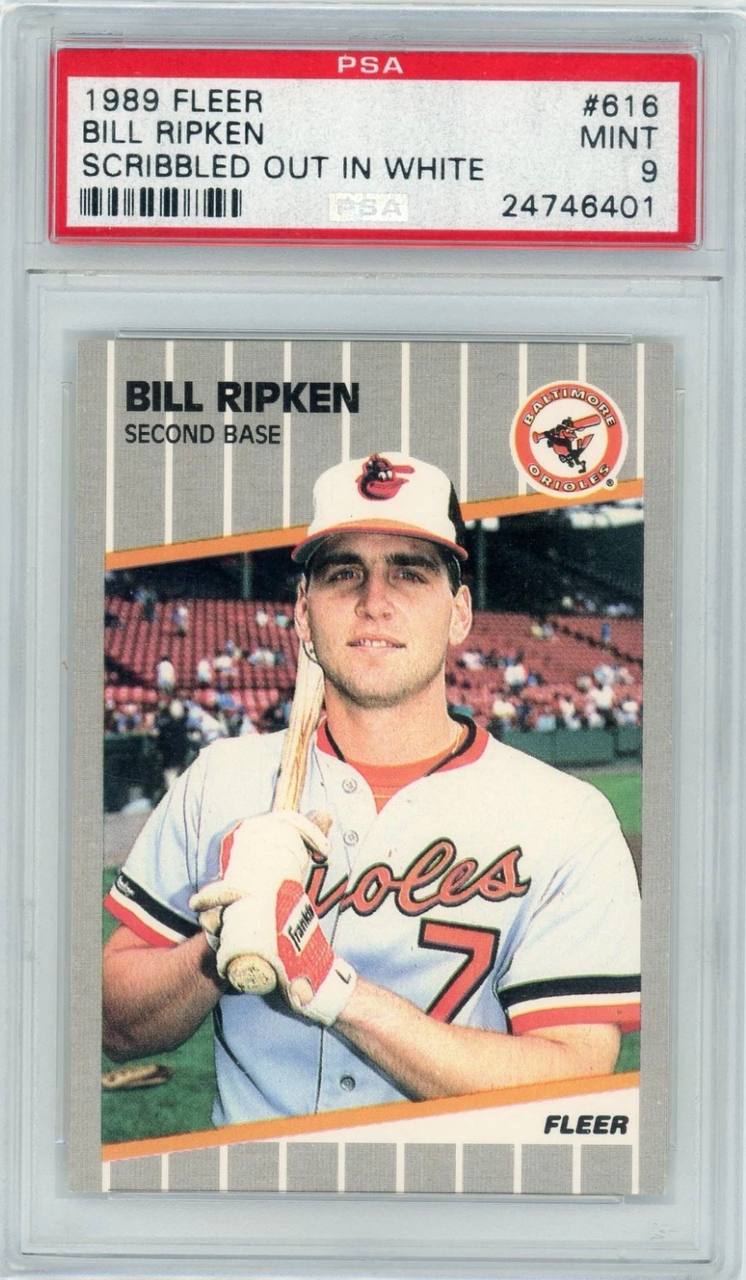
5. White Scribble (“Scribbled Out in White”)
Now we’re into serious scarcity territory. PSA has graded only 134 total copies across all grades, with approximately 14 in PSA 10.
This was Fleer’s earlier attempt at an airbrushed correction—a white streak applied over the text—distributed in very limited quantities before they moved to other methods.
In February 2025, a PSA 10 White Scribble sold on eBay for $4,915—a record at the time, reported by Sports Illustrated.
This is the chase card of the FF family.
6. Whiteout / White Box (“Whited Out Vulgarity”)
PSA graded approximately 162 copies total, with around 16 in PSA 10.
PSA 10 value: approximately $4,000 (May 2024 sale).
But here’s the problem: these are probably fake.
The authenticity of Whiteout cards has been actively debated by some of the hobby’s most serious Ripken FF researchers for decades. Veteran collector Donovan Ryan, who helped build BillRipken.com and has studied these cards for 30+ years, has expressed serious doubt about whether any Whiteout cards are genuine Fleer production. His position: these may all be post-production fakes.
PSA slabs them. The market buys them. Expert opinion on their legitimacy is divided.
Buy with full awareness that you might be holding a $4,000 counterfeit.
Additional Micro-Variants (For the True Completionist)
The Beckett-documented expert breakdown includes several more:
– Saw-Cut variations (Fleer manually cut large stacks of sheets to mark cards for removal before packing—many FF cards exist with and without these cuts)
– Circle Scribble (four distinct coverage levels, CS1 through CS4)
– Double Die print defects showing ghost/double impressions of the text
These are collector conversation pieces and genuine research targets for those chasing the true master set.
Values across the FF variant family range from a few dollars for raw Black Box corrections to thousands for high-grade rarities. The highest priced examples include:
White Scribble PSA 10: Record sale of $4,915 (February 2025)
Whiteout PSA 10: Approximately $4,000 (May 2024) — authenticity contested
Original FF PSA 10: $600–$750 range
Common raw variants (Original FF, Black Box, Black Scribble) trade between $10–$80 depending on condition and variant type. Prices fluctuate with media coverage and record sales — the White Scribble record in February 2025 drove fresh attention back to the entire FF family.
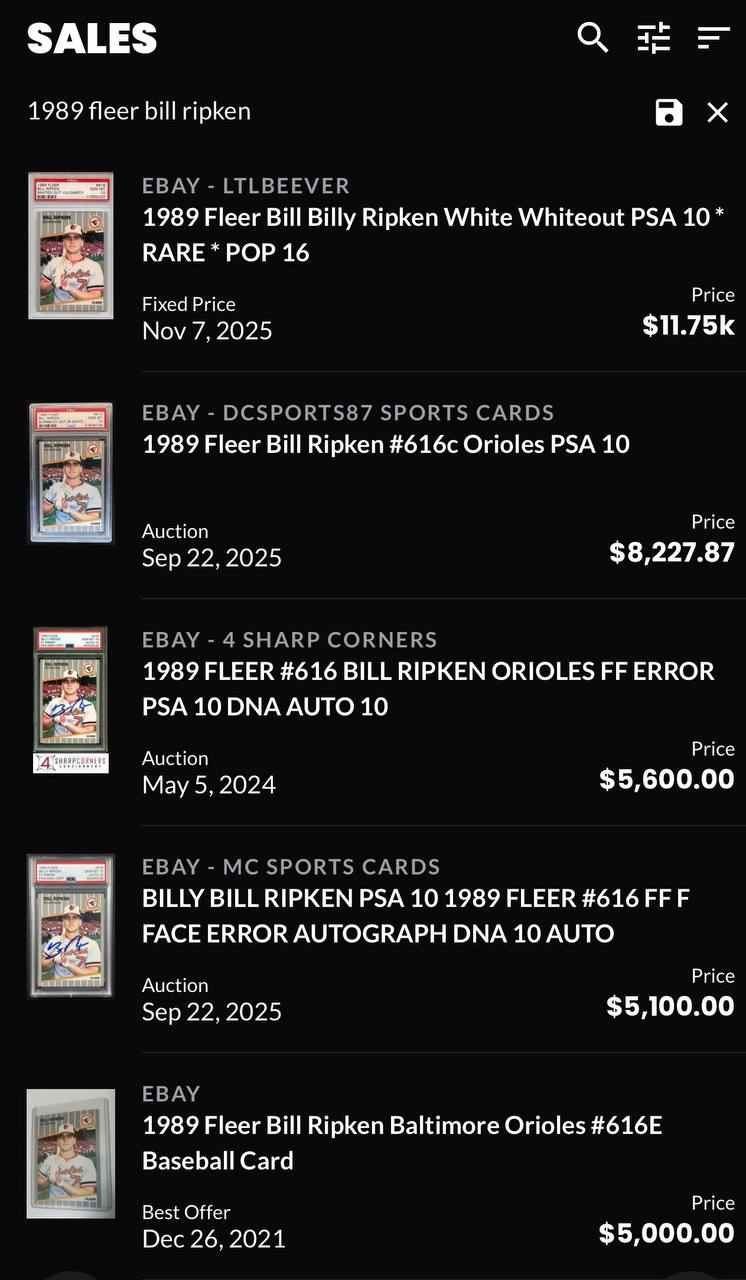
Highest Billy Ripken FF card sales tracked by Card Ladder. White Whiteout PSA 10 sold for $11,750 in November 2025 — the current record.
One data point worth noting: the Sports Card Investor tracking for the raw FF original shows it down about 18.6% over the 30 days ending February 2026, with the last sale at $64.57. The card moves in cycles, often spiking when a major graded sale gets media coverage—the February 2025 White Scribble record is exactly the kind of event that moves raw prices.
The Billy Ripken FF card is the junk wax era distilled into a single artifact. In one piece of cardboard, you get everything that era was: overproduction, zero quality control, manufactured (or accidental) controversy, media frenzy, and a hobby-wide panic that drove prices through the roof on a card that objectively should have been worth three cents.
But here’s what separates the Ripken FF from a thousand other junk wax curiosities: the variant structure.
Fleer’s panicked, patchwork attempts to “fix” the problem in real time—each correction slightly different from the last, distributed inconsistently, some in tiny quantities that nobody tracked—created a collecting puzzle that researchers are still unpacking 36 years later. The Saw-Cut sub-variants weren’t even widely documented until the internet era. The debate over Whiteout authenticity still hasn’t been settled. New data points emerge when a graded example sells for a record price and pulls fresh attention back to the card.
The FF card rewards obsession in a way few other junk wax cards do. The original is affordable—anyone can start there. The Black Box is twenty bucks. But if you want to build a true master set—every recognized variant, every sub-type, a genuine Saw-Cut example, the Glossy Black Box, a White Scribble in a meaningful grade—you are looking at a five-figure project minimum, years of hunting, and decisions about authenticity that you’ll have to make for yourself.
That’s the lesson here. The hobby doesn’t just reward scarcity. It rewards chaos. It rewards mistakes. It rewards the kind of institutional failure that creates collecting puzzles complex enough to keep researchers busy for decades.
Billy Ripken wasn’t a great player. He was barely a good one. But a batting practice bat, a distracted photographer, and a spectacularly asleep quality-control team—or, more likely, a calculated marketing stunt by a desperate card company—accidentally created the most interesting single-card variant run in the modern era of the hobby.
And the market is still paying for it.
In 2017, Billy Ripken sat down with Dan Patrick to discuss the card, the controversy, and what really happened behind the scenes. Watch the full interview on YouTube.

Written by
Grayson Bryce Thompson
Grayson writes about the sports card hobby — the money, the frauds, and the stories the industry doesn't want told. He's been collecting since the junk wax era and still has the boxes to prove it.