Fanatics Gave Breakers Pallets While Collectors Got ‘Sold Out’ Messages
Junk Wax Sal—ranked on SCR’s Hobby Influencer Rankings—posted what thousands of collectors are thinking:
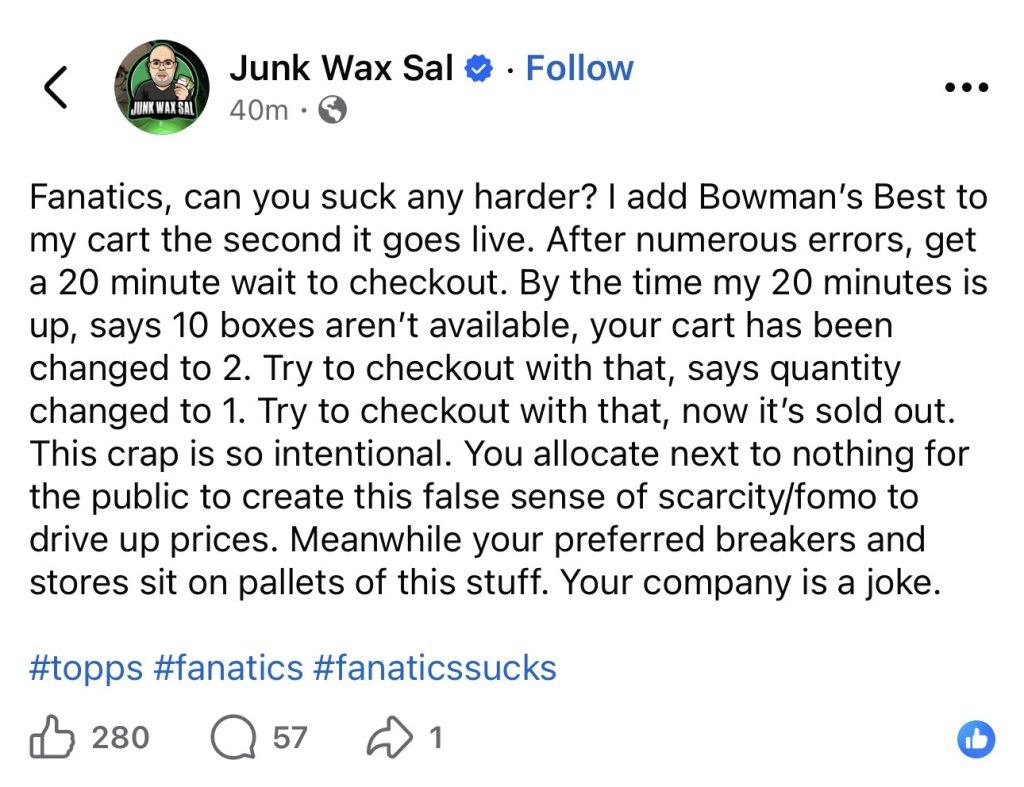
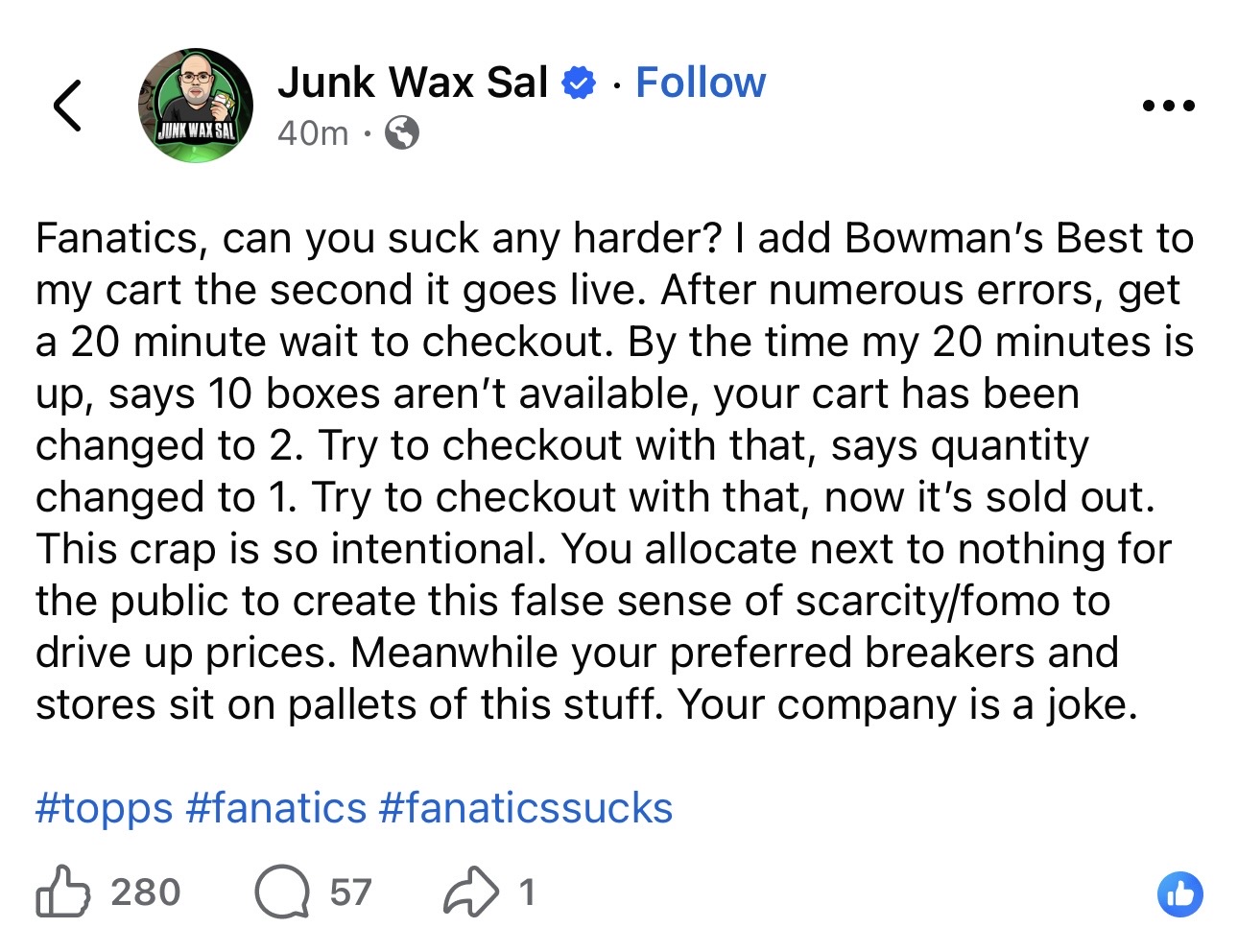
“Fanatics, can you suck any harder? I add Bowman’s Best to my cart the second it goes live. After numerous errors, get a 20 minute wait to checkout. By the time my 20 minutes is up, says 10 boxes aren’t available, your cart has been changed to 2. Try to checkout with that, says quantity changed to 1. Try to checkout with that, now it’s sold out.”
His conclusion: “This crap is so intentional.”
He’s not wrong.
The Pattern: Collectors Can’t Buy, Breakers Get Pallets
Fanatics releases sell out in minutes—sometimes seconds—on their website. Collectors deal with:
- Site crashes when products go live
- Checkout errors that waste time
- Inventory disappearing mid-checkout
- Cart quantities changing from 10 → 2 → 1 → sold out
Meanwhile, breakers and card shops sit on pallets.
It’s not a capacity issue. Fanatics produces enough product. The question is: who gets it?
Where the Product Actually Goes
When Bowman’s Best “sells out” on Fanatics.com in 10 minutes, where did it go?
- Breakers – They buy pallets directly, break them on livestreams, and sell individual spots
- Card shops – Allocated cases and boxes to sell at markup
- Preferred accounts – Dealers with direct relationships get priority access
- Resellers – Product appears on eBay and secondary markets within hours at inflated prices
Regular collectors? They get a 20-minute checkout queue and a “sold out” message.
Proof: The Shohei Ohtani 1/1
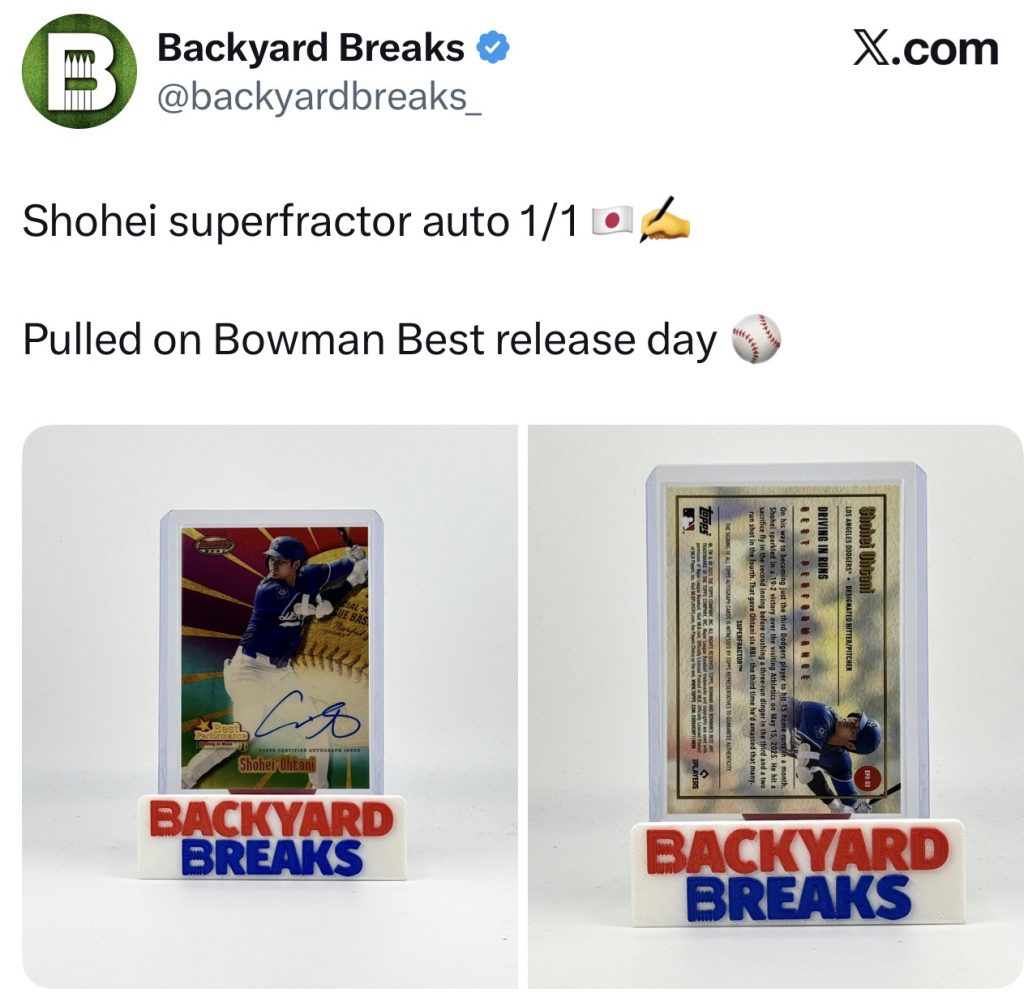
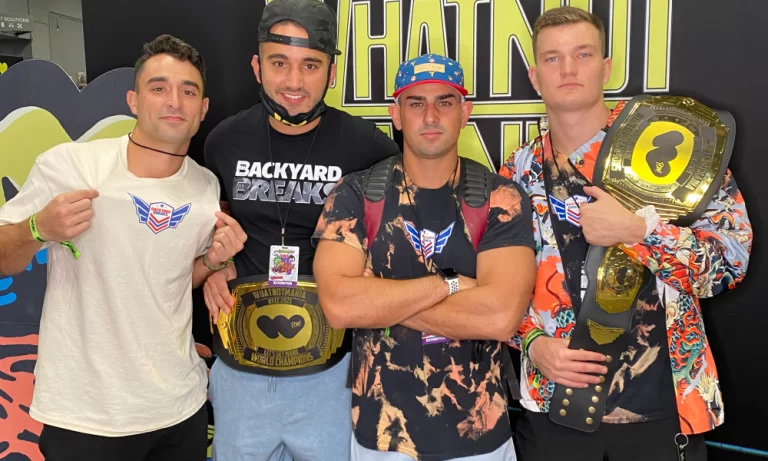
On release day for 2026 Bowman’s Best, while collectors fought checkout errors and sold-out messages, Backyard Breaks pulled a Shohei Ohtani 1/1.
Think about that.
It’s the Sneaker Drop Playbook
This is nothing new. The sports card hobby is just catching up to what’s been happening in other markets for years:
Concert Tickets (Ticketmaster)
- Tickets “sell out” instantly
- Resale sites immediately list them at 3x-5x face value
- Fans blame bots, but the real issue is allocation: huge blocks go to resellers, VIP packages, and “preferred partners”
- Typically if you wait, tickets magically get discounted near concert date
Sneaker Releases (Nike, Adidas, Yeezy)
- Limited drops create artificial scarcity
- Bots and resellers dominate
- Regular customers enter raffles they never win
- Shoes appear on StockX minutes later at markup
Gaming Consoles (PS5, Xbox)
- Launch inventory “sold out” before most people could checkout
- Scalpers listed them immediately at double the price
- Retailers claimed it was demand, but allocation favored bulk buyers
The hobby is using the same playbook: Create scarcity, funnel product to preferred buyers, let the secondary market inflate prices, and blame “high demand.”
The Artificial Scarcity Problem
Junk Wax Sal’s frustration isn’t about one box of Bowman’s Best. It’s about a system designed to create FOMO (fear of missing out):
Step 1: Announce Limited Release
Fanatics announces a product drop. Collectors mark their calendars.
Step 2: Allocate Most Inventory Off-Platform
Before the public sale, the majority of product goes to:
- Breakers (cases)
- Shops (boxes)
- Preferred dealers (priority allocation)
Step 3: Public “Sale” with Minimal Inventory
What’s left goes on Fanatics.com. Collectors rush to buy. Site crashes or queues slow them down.
Step 4: “Sold Out” Message
By the time most people get through checkout, it’s gone.
Step 5: Secondary Market Markup
Within hours, the same product appears on eBay, breaker livestreams, and dealer sites—at higher prices.
The result: Collectors who wanted to buy at retail now have to pay a premium on the secondary market. Fanatics (and their partners) profit twice.
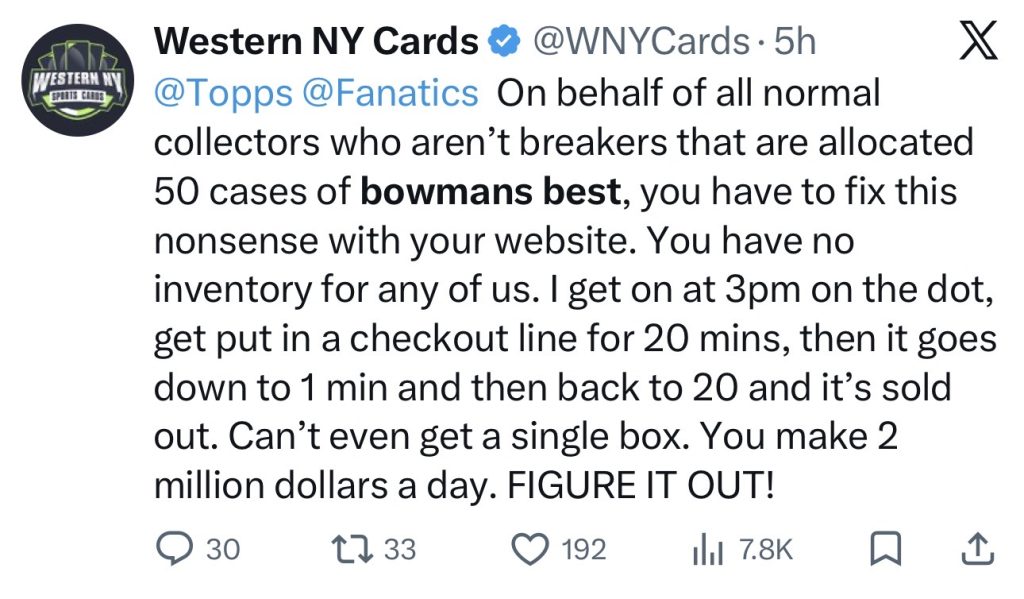
“Meanwhile, Your Preferred Breakers and Stores Sit on Pallets”
This is the line that stings.
Breakers aren’t buying one box at a time on Fanatics.com. They’re getting cases directly. Card shops aren’t fighting through checkout queues. They’re getting allocated boxes.
Why?
Because Fanatics makes more money selling in bulk to businesses than they do selling retail to individual collectors. And those businesses—breakers and shops—drive ongoing revenue through breaks, memberships, and repeat customers.
Collectors are the end users, but they’re not the priority customers.
It’s Not About Bots (This Time)
In sneaker drops and concert tickets, bots are the villain. They auto-checkout faster than humans can type.
But in the hobby, the issue isn’t bots—it’s allocation.
Even if every human collector got a fair shot at Fanatics.com inventory, it wouldn’t matter. Because the vast majority of the product never makes it to the public sale.
Junk Wax Sal’s complaint isn’t “bots bought it all.” It’s “you allocated next to nothing for the public to create this false sense of scarcity/FOMO to drive up prices.”
That’s not a technical problem. That’s a business model.
Why Fanatics Does This
1. Higher Margins on Bulk Sales
Selling pallets to breakers is more efficient than managing thousands of individual retail transactions.
2. Secondary Market Hype
When product “sells out” instantly, it creates buzz. Scarcity drives demand. Demand justifies higher prices on future releases.
3. Breaker Partnerships
Breakers drive engagement. They stream breaks, build communities, and keep people invested in the hobby. Fanatics benefits from that ecosystem.
4. Retailer Relationships
Card shops are Fanatics’ distribution network. Keeping them stocked ensures product reaches local markets.
5. FOMO Marketing
“Sold out in 10 minutes!” is better marketing than “still available.” It makes the next release feel urgent.
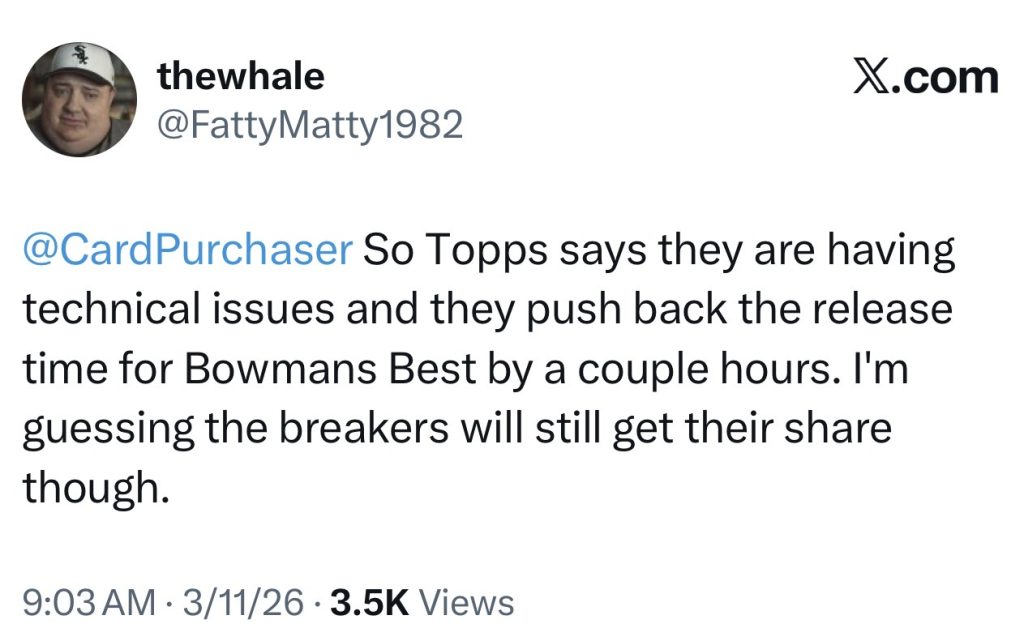
What Collectors Want (And Won’t Get)
Fair Allocation
If Fanatics produces 10,000 boxes of Bowman’s Best, collectors want a reasonable percentage available for retail purchase—not just the scraps left after breakers and shops get theirs.
Transparent Inventory
How many boxes actually go to public sale vs. breakers/shops/dealers? Fanatics won’t say.
No Preferential Treatment
Why do some accounts get priority access? If it’s first-come, first-served, then everyone should start from the same line.
Functioning Checkout
At minimum, the website should handle traffic without crashing, changing cart quantities, or timing people out mid-purchase.
None of this will happen. Because the current system works—for Fanatics, for breakers, and for shops. It just doesn’t work for regular collectors.
The Bigger Question: Is This Sustainable?
Concert tickets went through this. Sneakers went through this. Gaming consoles went through this.
In every case, the result was the same:
- Casual fans gave up – If you can’t buy tickets/shoes/consoles without fighting bots and paying markups, you stop trying
- Resentment grew – Fans turned on the companies that prioritized resellers over customers
- The market corrected – Eventually, hype died down, demand normalized, and the artificial scarcity model stopped working
The hobby is heading the same direction.
When collectors can’t buy product at retail, they either:
- Pay inflated secondary market prices (unsustainable for most budgets)
- Stop collecting new releases (kills long-term demand)
- Leave the hobby entirely (shrinks the customer base)
Fanatics is betting that FOMO and artificial scarcity will keep driving sales. But if regular collectors get shut out too many times, they’ll stop caring.
The Bottom Line
Junk Wax Sal’s frustration is justified. And it’s not unique to him—it’s what thousands of collectors experience every time Fanatics drops a new product.
The issue isn’t site crashes or checkout errors. It’s allocation.
Product doesn’t “sell out” because demand is too high. It sells out because most of the inventory never makes it to the public sale in the first place.
Breakers get pallets. Shops get some boxes. Preferred dealers get priority access. And collectors get a 20-minute queue that ends in “sold out.”
That’s not a bug. That’s the business model.
Have you been shut out of a Fanatics release? Email us: tips@sportscardradio.com

Written by
Grayson Bryce Thompson
Grayson writes about the sports card hobby — the money, the frauds, and the stories the industry doesn't want told. He's been collecting since the junk wax era and still has the boxes to prove it.




Not a breaker, not a reseller. Lost my Topps Independent Distributor when they fired all the breakers, no one ever talked about the distributors. Went from 5-10 cases of the main releases, to having bought nothing this year. No Series 1, no 2026 Heritage. Turns out they ruined Stadium Club anyways, and now people are starting to figure out there are no SPs in Heritage, even though the price went up $20 and there are 4 packs less per box now. Seriously, FOUR PACKS. That’s 384 cards per case. Have fun with that, I’ve been stockpiling vintage for the last 4 years.
THIS! The “Hobby” vs. The Reality As a 48-year-old returning to the hobby after 30 years, last month, ripping a Topps Series 1 box brought back all the nostalgia I lost when my childhood collection was stolen.
But yesterday’s Bowman’s Best drop was a wake-up call. I was actually excited to buy those cards. I don’t typically get excited about this type stuff but in this case, I was. I spent all day refreshing, survived a 20-minute queue, and clicked “buy” within seconds, only to be told it was sold out. An hour later, those same boxes were on eBay for double the price or more.
I’m not in this for the “investment” or the money; I just want the thrill of the hunt. But when multi-million dollar companies can’t handle volume and the system favors bots, breakers, and scalpers over genuine collectors, it’s hard to stay.
It took the joy out of it. I had fun for a month, but this might not be the hobby for me anymore.